Your wallet has an inbox.

A wallet-native private communication network — encrypted messages, permissioned contact, and settlement inside the same conversation. This page is the whole position: what runs today, what does not, and what has not been decided.
Null Network is a project concept. Nothing here is deployed, no token has been issued, no contract has been audited, and nothing on this page is an offer to sell or a solicitation to buy any asset.
At a glance
Six lines a reader scans before deciding whether to keep reading. Every one of them comes from the chain config or from the relay's own behaviour.
Then decide.

- Stage
- ConceptNothing deployed
- Network
- Robinhood ChainArbitrum Orbit L2
- Chain ID
- 46630x1237
- Block time
- ~100 msOrbit sequencer
- Gas token
- ETH18 decimals
- Settlement Not set
- USDGUnconfirmed
Value found its rails.
Everything around it did not.
- 01
A wallet can send value and nothing else
Every negotiation around an on-chain transfer happens somewhere else — a group chat, a DM, an email thread — where the counterparty is a screen name, the agreement is a screenshot, and the platform holding all of it is not the one holding the money.
- 02
The address is already the account
It is verified, portable, and carries a keypair. Messaging keyed to it needs no phone number, no email, and no signup: prove the address, derive a messaging key, publish the public half. Two signatures, and the inbox exists.
- 03
Attention is the thing worth pricing
ProposedA stranger cannot message you; they can knock, and a knock can carry a refundable bond. Accepted conversations carry payment requests that settle on-chain. That is the proposed revenue surface — pricing access, not reading messages.

They can knock. That is all.
How it works
Four moves. None of them asks for an email.

Connect
Connect an EVM wallet and sign in. Two signatures: the first proves you control the address, the second derives the messaging keypair.
No password · no email · no phone number

Claim an ID
Publish a handle and a public key against your address. Anyone can resolve the handle to the key; nobody can read a message without it.
Relay record · no gas · no transaction
Knock
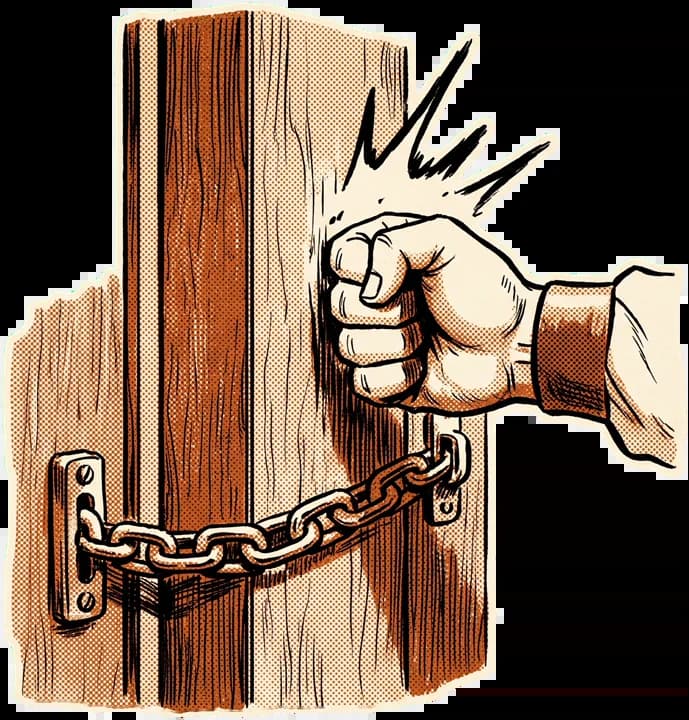
You cannot be messaged without permission. A stranger sends a knock; you accept, reject, or block it. Nothing reaches the inbox before you decide.
Blocking is silent — a blocked knock goes nowhere
Talk, then settle
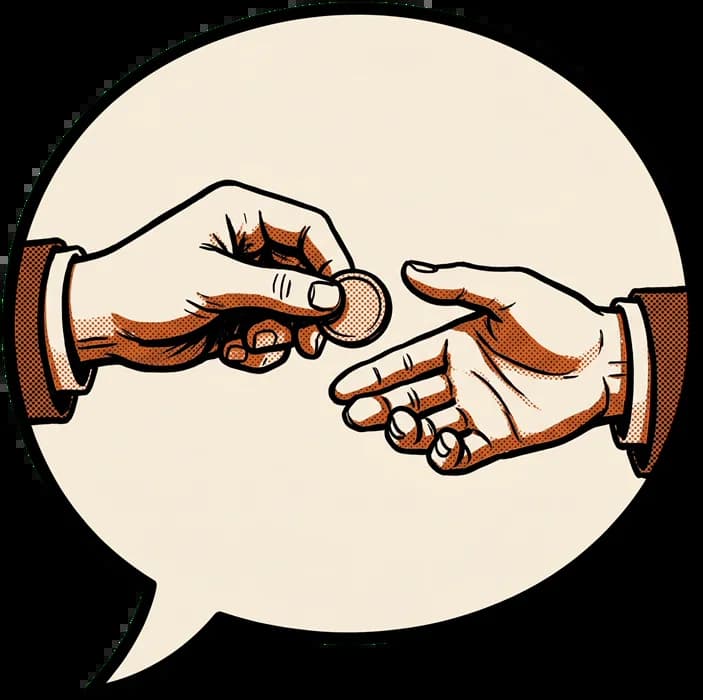
Messages are sealed to your published key with a fresh ephemeral keypair. A payment request lives in the thread and settles on-chain in USDG.
Amounts carried as integer minor units, 6dp
- Wallet
- Any EVM browser wallet
- Network
- Robinhood Chain · 4663
- Gas
- ETH — the chain's native token
- Settlement
- USDG · address unconfirmed
Token & supply
A distribution on the table, not a cap table. No token exists, none has been issued, and there is no sale.

- Total supply
- 1,000,000,000
- Network
- Robinhood Chain · 4663
- Standard
- ERC-20
- Contract
- Not deployed
- Float at TGE
- 6.0%
- Relay incentives
- 32%
- 48-month linear emission
- Ecosystem & grants
- 18%
- 6-month cliff, 36-month linear
- Core contributors
- 17%
- 12-month cliff, 36-month linear
- Early backers
- 15%
- 12-month cliff, 24-month linear
- Treasury
- 12%
- Released by governance vote
- Public distribution
- 6%
- Unlocked at listing
- No token is issued. There is no sale, no allowlist, and no private round.
- The distribution above is a model under discussion, not an agreed cap table.
- USDG's Robinhood Chain address is unconfirmed, so settlement is unconfigured.
- No smart contract exists, therefore none has been audited.
- No legal or securities review has been completed in any jurisdiction.
Point a wallet at the network
Robinhood Chain is an Arbitrum Orbit L2 with ETH gas and sub-second blocks (~100ms). One-click add or manual RPC configuration.

The relay is a standalone zero-knowledge forwarder. It routes encrypted packets without storing unencrypted metadata.
What's built
3 of 8 capabilities run end to end today. The rest are named here rather than implied by silence.
- Wallet sign-inWorking
- Nonce, signature, session token. Two signatures — one proves the address, one derives the messaging key.
- Encrypted messagingWorking
- nacl.box sealed against the recipient's published key, a fresh ephemeral keypair per message. A test asserts the relay never holds plaintext.
- Knock permission layerWorking
- Accept, reject, block. A blocked sender's knock returns 201 and goes nowhere — telling them otherwise invites a fresh identity.
- Payment requestsPartial
- Requests, receipts, and integer minor units end to end. Settlement records the hash the client supplies; nothing reads the chain to verify it.
- Anti-spam bondsPartial
- The bond amount travels with the knock. No contract locks it and no contract returns it.
- Groups and file sharingNot built
- Conversations are one-to-one. Group keying and file transport are Phase 2 work.
- Multi-device historyNot built
- Keys re-derive from a signature; history does not transfer. Your sent copy lives in localStorage by design.
- Relay decentralisationNot built
- State is a single JSON file today. Fine for an MVP, not for a network, and not rate-limited.
Order of work
No dates, because there are none to give. What is fixed is the order: nothing in a later phase is safe to start before the one above it is done.
- Phase 00In hand
The concept, in working code
- Relay, encryption, and the knock layer running end to end
- The archive published as 31 records, each with a status label
- Robinhood Chain wired in as the launch network
- Phase 01Next
Make it safe to look at
- Independent cryptographic review and application-security testing
- Rate limiting, abuse handling, and key rotation
- A confirmations worker that verifies settlement against the chain
- Phase 02Later
Make it a network
- Multiple relays, with delivery that survives any one of them
- Groups, file transport, and multi-device history
- Bonds settled by contract rather than recorded by the relay
- Phase 03Later
Hand it over
- Governance over treasury and emission
- Smart-contract audits published in full
- Legal and securities review before any distribution
Read this part twice
Five things a reader is most likely to get wrong about what is on this page.
- 01
Encryption is not anonymity
Who talks to whom, when, and how often is visible to the relay. So are Null IDs, handles, public keys, and controlling addresses.
- 02
Payment metadata is in the clear
Amount, purpose, and participants are stored unencrypted so receipts can be rendered, and settlement happens on a public chain.
- 03
Nothing here has been audited
No security review, no cryptographic review, no contract audit, no threat model. This should not be deployed, and money should not be committed to it, until all four exist.
- 04
There is no token and no sale
Any offer to sell you one is a fraud. Null will never request a seed phrase or a private key, and will never message you first.
- 05
A concept can be abandoned
Null Network is a project concept. Nothing in the repository is a deployed network, and no capability carries a delivery commitment.
Null will never request a seed phrase or a private key, and will never message you first. Anyone offering to sell you a NULL token is defrauding you.
Nothing on this page is an offer to sell or a solicitation to buy any asset.Your wallet
has an inbox
An EVM wallet in the browser is all the app needs. It talks to a relay you can run yourself, and it will tell you plainly when that relay is not there.